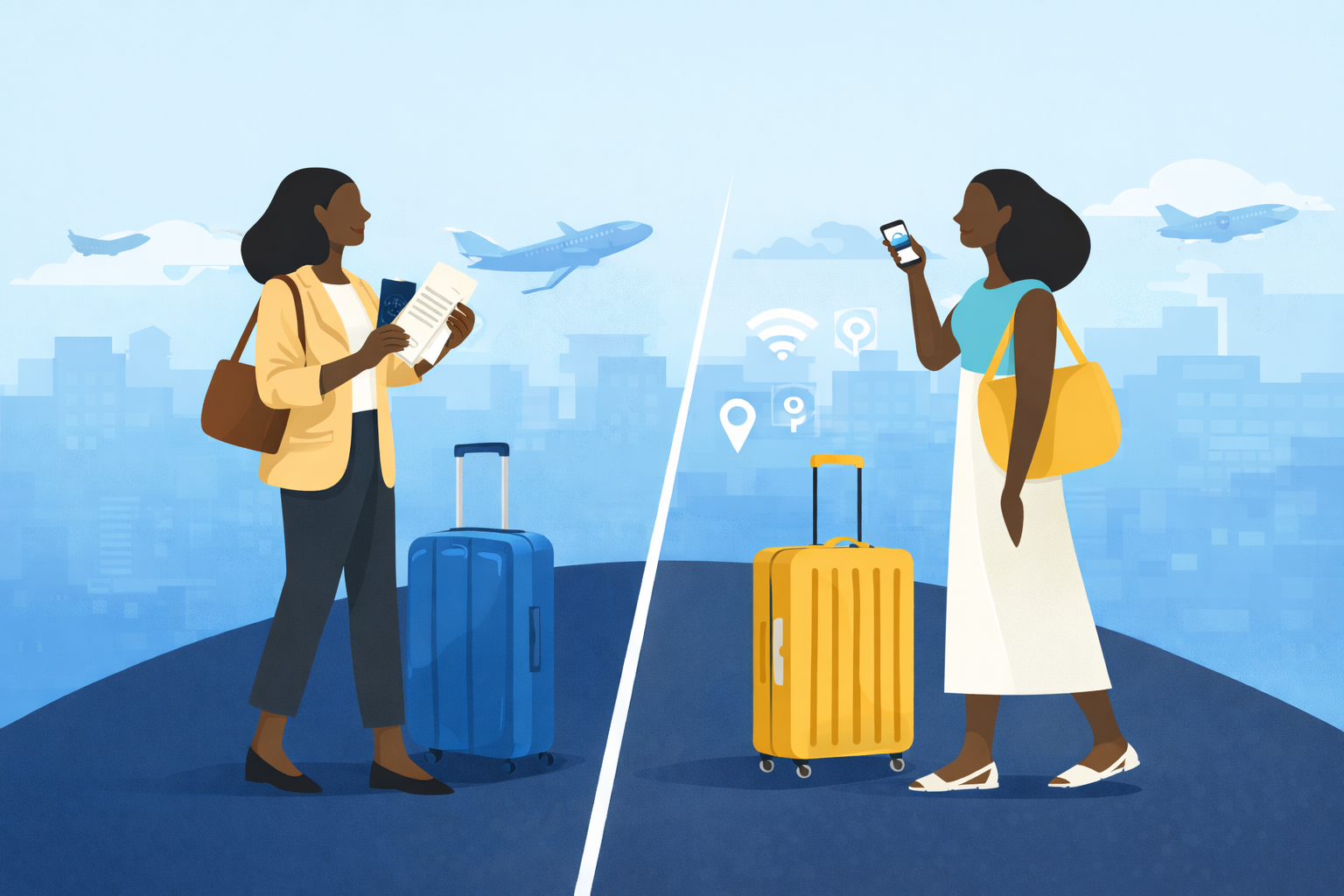
Take a moment to think back to how you traveled in 2006. Your boarding pass was printed. Your itinerary was probably printed, too—along with hotel confirmations, rental car receipts, and directions from MapQuest. And if you had a connection? You crossed your fingers that everything ran on time.
In other words, travel required a lot of paper—and a little bit of luck.
This was the world before smartphones, before travel apps, and before real-time alerts told you your gate had changed or your flight was delayed. Staying organized meant keeping track of every confirmation email and hoping you didn’t lose the one document you needed.
That same year, TripIt was founded with a simple goal: bring calm and organization to the chaos of modern travel. Instead of juggling printouts and emails, travelers could finally see their entire trip in one place.
Fast-forward to today, and the way we travel looks completely different.
Booking then vs. now: The rise of the DIY traveler
Planning a trip in 2006 often meant opening several browser tabs—and maybe calling a travel agent to piece things together. Airline websites were improving, but the process still involved printing confirmation pages, saving email receipts, and manually tracking every reservation for flights, hotels, and rental cars.
Price comparison tools existed, but they were early and limited. Finding the best route or deal often meant searching multiple sites and keeping careful notes along the way.
Today, it’s a completely different experience.
Related reading: 20 Moments and Milestones That Defined TripIt
Travelers can book flights, hotels, and activities with just a few taps. Confirmations arrive instantly. Itineraries sync automatically. And smart tools help travelers track prices, monitor flights, and plan trips more efficiently.
TripIt helped pave the way for this shift. Its email-forwarding feature—simply sending booking confirmations to TripIt—automatically created a master itinerary for your trip.
At the time, that was a game-changer. Suddenly, all those scattered travel emails turned into one organized plan.
Analog to digital: What travel was like before smartphones
It’s easy to forget that in 2006, smartphones weren’t part of the travel routine.
The first iPhone wouldn’t launch until the following year. So travelers relied on printed directions, guidebooks, and handwritten notes to get around.
Need directions to your hotel? Print them before leaving home. Need to check your gate? Watch the airport departure board. Need to check in? Get in line at the airport counter.
Today, most of those steps happen on a single device. Boarding passes live on your phone. Navigation apps guide you through unfamiliar cities. Real-time alerts notify you about delays, gate changes, and weather disruptions.
TripIt brings all those details together: keeping your itinerary, travel documents, and alerts in one place so you’re never scrambling for information. What once required a folder full of papers now fits in your pocket.
How airline travel has changed
Air travel looked a little different back then, too. In 2006, legacy airlines still dominated the skies, and many travelers enjoyed perks that have since changed—like free checked bags and fewer extra fees.
Boarding passes were paper stubs. Seat assignments sometimes involved handwritten slips. And inflight entertainment usually meant shared overhead screens or flipping through the airline magazine.
Around that time, airlines were just beginning to experiment with digital check-in options.
TripIt quickly adapted to the changing landscape, launching our first iPhone app not long after airlines began rolling out mobile check-in.
Today, the airport experience is far more digital. Travelers receive real-time flight alerts, select seats using interactive seat maps, and—at some airports—even board using biometric technology.
TripIt enhances that experience with features designed to keep travelers informed along the way. TripIt Pro Risk Alerts notify travelers about potential disruptions; meanwhile, Neighborhood Safety Scores warn you if you’re planning to visit an area that exceeds your safety threshold.
Luggage and packing trends: From heavy to hybrid
Packing has evolved, too. Back in 2006, most travelers used soft-sided luggage or two-wheel roller bags. Hard-shell suitcases were less common, and travel accessories like packing cubes weren’t yet a staple.
Checking a bag was standard practice—especially for longer trips. Carry-on-only travel was more common among frequent business travelers.
Fast-forward to today, and the luggage landscape looks very different. Lightweight spinner suitcases glide through airports. Packing cubes help maximize space. And many travelers aim to travel carry-on only to skip baggage claim altogether.
Technology has also entered the luggage world. Bluetooth trackers and airline apps now let travelers keep tabs on their bags in real time.
How global flight routes have expanded
The global travel map has expanded dramatically over the past two decades.
In 2006, nonstop international flights were less common, and ultra-long-haul routes were still relatively rare. Many trips required multiple connections, and travelers often relied on airport monitors to track departure information.
Today, airlines connect cities across the globe with more direct routes than ever before. Ultra-long-haul flights link continents that once required several stops, and low-cost carriers have made international travel more accessible.
Managing these complex trips is easier, too. TripIt users can track every step of their journey—from boarding times to baggage claim—without jumping between airline websites or airport screens.
From paper itineraries to digital travel planning
In 2006, travel required patience, preparation, and a stack of printed documents. Today, travel is faster, smarter, and far more connected. The tools travelers rely on—from mobile boarding passes to automated itineraries—have transformed how we plan, navigate, and experience the world.
When TripIt launched in 2006, the idea was simple: make travel easier to manage. Two decades later, that vision has grown alongside the technology that powers modern travel.