Power banks have become an essential part of travelers' packing lists, but lithium battery-related incidents are on the rise. In 2025, the Federal Aviation Administration (FAA) reported 97 verified incidents involving lithium batteries—up from 54 incidents in 2021. As of publication, there have been 58 verified incidents in 2026.
While not all of these lithium battery incidents involved power banks (e.g., some involved laptops or e-cigarettes), the International Air Transport Association (IATA) is moving ahead with new rules to keep passengers safe. Here’s what travelers need to know to comply with those rules come January 1, 2027.
What are the current rules for flying with power banks?
Let’s start with what you need to know about the rules currently in effect. The IATA, i.e., the main global trade association for airlines, sets rules and guidelines for commercial passenger flights.
Their rules state that power banks:
- Must be in your carry-on luggage only. They should never be in your checked bag.
- Should be under 100 watt-hours (Wh), otherwise they require special approval from your airline.
- That are 100-160 Wh might be allowed, but typically require airline pre-approval.
- Over 160 Wh are not allowed on passenger flights.
That said, some airlines enforce stricter rules when it comes to flying with power banks. For example, American Airlines limits passengers to two power banks and they cannot be larger than 100 Wh. They cannot be placed in checked luggage nor stored in an overhead bin. If you’re using one, it needs to be visible and/or kept in an easily accessible place (such as your seatback pocket). You also cannot plug the power bank into the plane’s power outlet to recharge it.
Many global carriers have stricter rules, as well. Emirates allows passengers to bring just one power bank onboard, it must be under 100 Wh, and the capacity marking must be clearly visible. You’re not allowed, however, to use it to charge your phone or recharge it on the plane. It has to remain under your seat or in the seat pocket; it cannot be placed in the overhead bin.
EVA Air has a similar take, prohibiting the use and charging of power banks altogether.
What are the new rules flyers need to know?
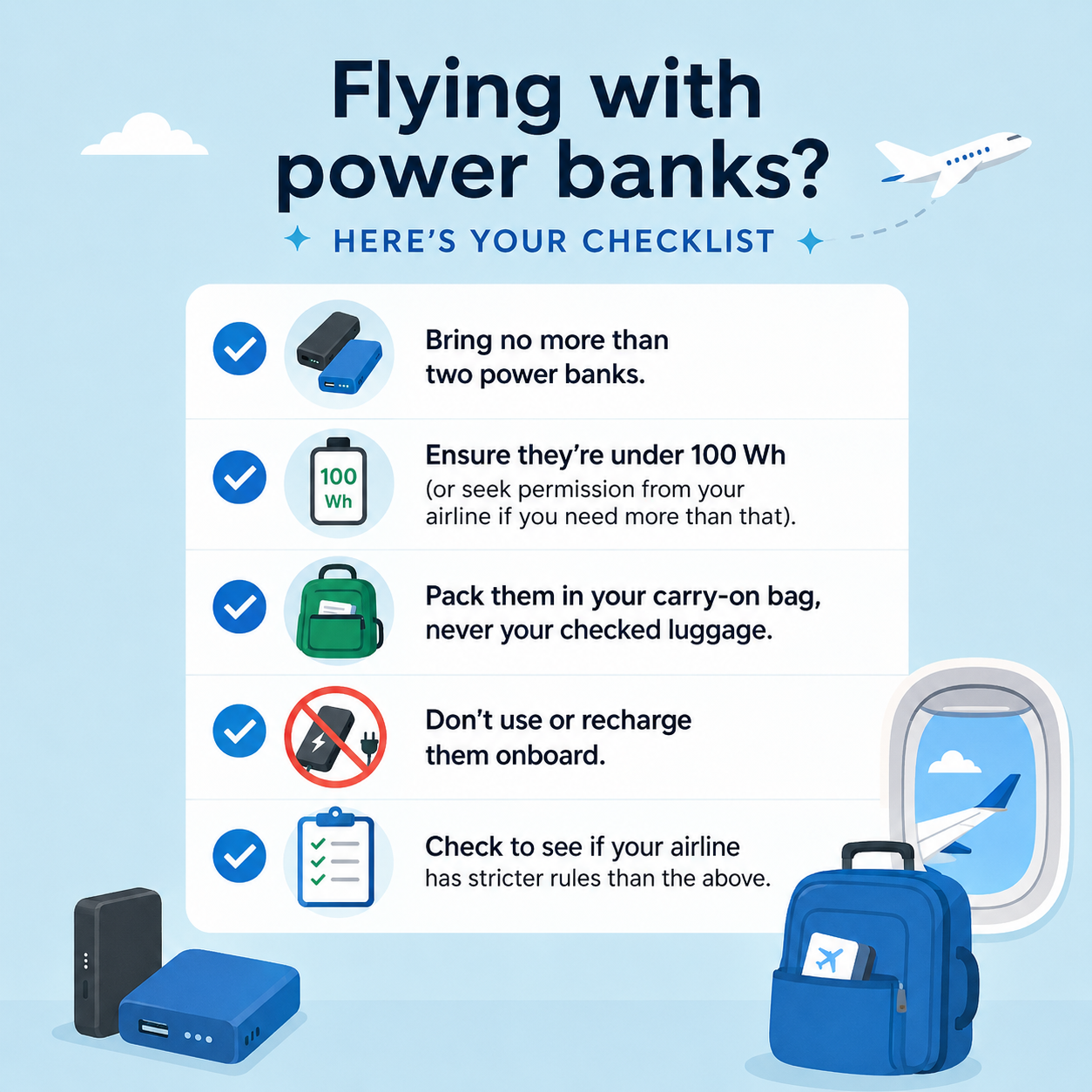
Earlier this year, the IATA announced that they’re updating their guidance for airlines, stating that power banks must not be recharged while onboard the aircraft; they should not be used to recharge a portable electronic device while onboard the aircraft; and each passenger is limited to no more than two power banks. These changes go into effect January 1, 2027.
For many travelers, these new rules align with their packing plans already. But if they don’t, here’s a quick checklist to help you remember the changes:
Frequently asked questions about flying with power banks
Can I bring a power bank on a plane?
Yes. Power banks are generally allowed on passenger flights, but they must be packed in your carry-on luggage, not your checked bag. Power banks under 100 Wh are typically permitted without airline approval, while those between 100 and 160 Wh may require approval. Power banks over 160 Wh are not permitted on passenger flights.
Can I use a power bank to charge my phone on a plane?
Under IATA's new guidance taking effect January 1, 2027, passengers should not use power banks to charge phones, tablets, or other portable electronic devices during a flight. Power banks also must not be recharged using the aircraft's USB ports or power outlets.
How many power banks can I bring on a plane in 2027?
Beginning January 1, 2027, IATA's updated guidance limits passengers to no more than two power banks. However, individual airlines can impose stricter limits. Emirates, for example, currently permits just one power bank per passenger.
Can I put a power bank in my checked luggage?
No. Power banks contain lithium-ion batteries and must be carried in the aircraft cabin. They should never be packed in checked luggage. If your carry-on bag needs to be checked at the gate, remove your power bank and keep it with you in the cabin.