
From personalized alerts to AI-assisted planning, travelers have more and more tools to help them prepare for and stay informed about their trips.
TripIt’s partner Riskline powers one such tool—monitoring travel risk intelligence 24/7/365 in more than 220 countries and territories. They calculate risk levels to deliver real-time alerts (like TripIt Pro Risk Alerts), in-depth destination risk assessments, travel entry requirements, and more.
To better understand the global travel landscape, including risk alert volume and trends, as well as geographic patterns and hotspots, we worked with Riskline to analyze their historically published alerts.
Based on our analysis, we identified five key insights shaping travel-related safety and risk around the world. We also asked industry experts to weigh in with their advice for applying these insights to help folks stay informed.
Here’s what we found:
1. Travel-related risk alerts rose 15% in the past year
Travel-related risk alerts, which include those related to travel safety, severe weather, geopolitical crises, and disease outbreaks, rose 15% from 2024 to 2025.
This might seem like a significant year-over-year increase. However, travel industry experts weren’t alarmed—attributing the rise in alerts to broader visibility into disruption, rather than a blanket surge in danger.
“The increase in alerts underscores just how many different natural and man-made factors can impact a traveler’s journey today—from extreme weather events to geopolitical disruptions to even airport construction,” said Jen Moyse, Vice President of Product at TripIt. “This doesn’t necessarily mean the world is objectively more dangerous. Rather, we now have increased visibility into potential issues.
“Having access to this level of information allows travelers to prepare smarter and build flexibility into their plans,” added Moyse. “That wider lens surfaces more moments that matter to travelers, so the volume goes up. The takeaway isn’t don’t go. It’s go informed.”
“The takeaway isn’t don’t go. It’s go informed.” - Jen Moyse, Vice President of Product at TripIt
Suzanne Sangiovese, CEO of Riskline, echoed Moyse’s sentiment. She emphasized that alerts increase both traveler preparedness—and responsiveness.
"By keeping travelers informed about relevant disruptions, without overwhelming them, they can plan smarter, prevent inconveniences, and travel with confidence,” said Sangiovese.
2. Due to its size and flight volume, the U.S. sees the most alerts
According to Riskline data, the U.S. consistently generates high alert volumes, driven by its large size, significant flight volumes, severe weather, frequent protests, and shootings.
Case in point: At the time of publication, the U.S. government shutdown is impacting air travel. Flight disruptions are taking place at airports nationwide. Meanwhile, absences of essential workers, such as Transportation Security Administration (TSA) agents or Customs and Border Patrol (CPB) agents, are delaying screening security at airports and border crossings.
Even before the shutdown, the U.S. had the most travel-related risk alerts in the past year. The U.S. was followed by countries experiencing overlapping crises: the Israel-Iran war and the brief India-Pakistan conflict triggered alerts about the conflicts themselves and related air travel disruptions.
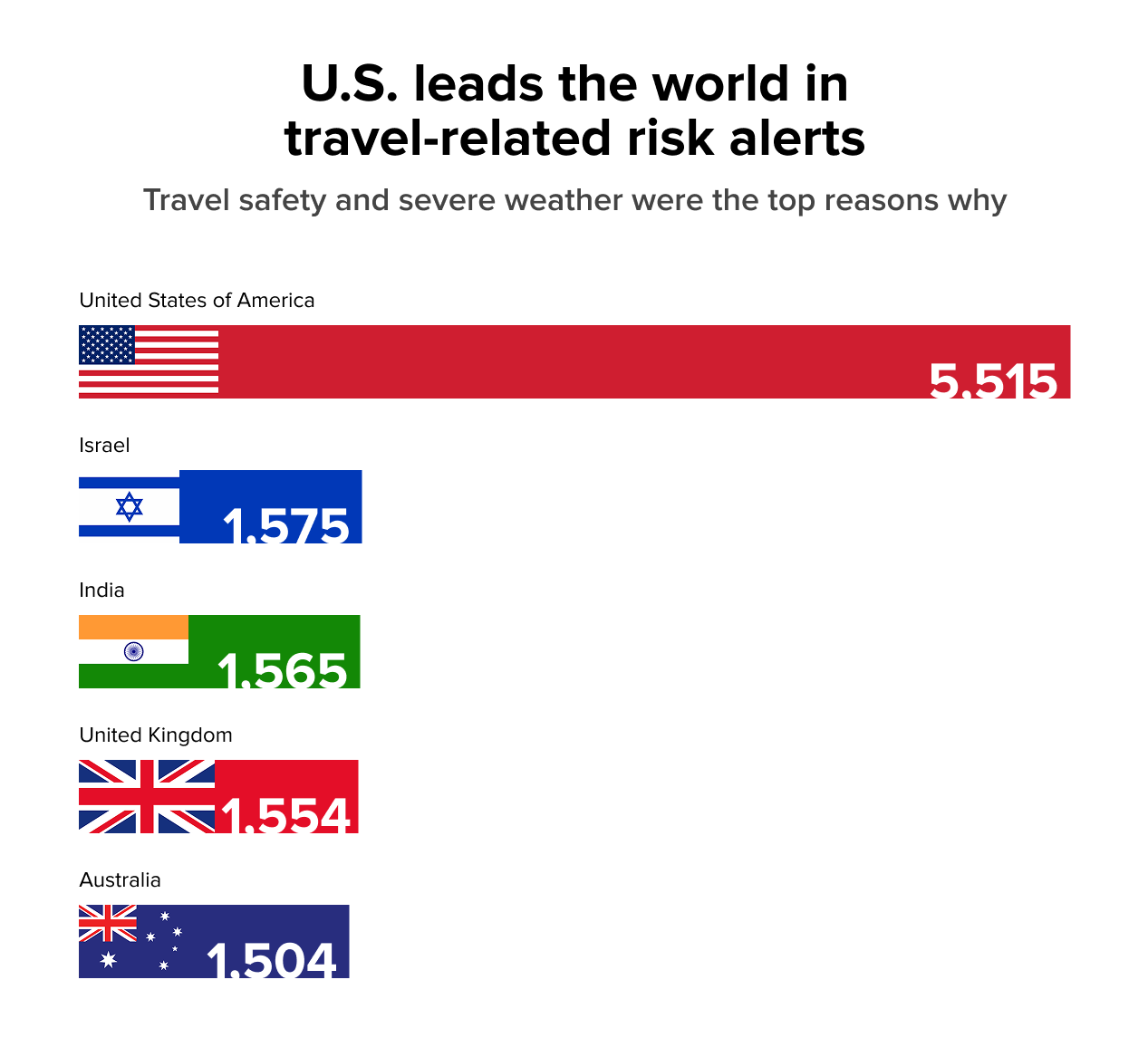
But geopolitical clashes weren't the most common alerts for these countries. In fact, travel safety and disruptions, followed by natural and environmental risks were.
What do these risks entail? Travel safety and disruptions covers a wide range of incidents and is often used when the exact nature of an event is unclear (e.g., police operations or suspicious devices). Meanwhile, natural and environmental alerts cover severe weather events and environmental conditions that contribute to major travel and service disruptions (such as heatwaves or seasonal heavy rainfall).
Read more: Get Ahead of Travel Disruptions With TripIt Pro Risk Alerts
“Given the constant stream of alarming headlines, many travelers may assume the world is simply too risky to explore, whether internationally or even domestically,” shared Moyse. “Often those perceptions are exaggerated compared to on-the-ground realities, and the analysis of Riskline data shows nuance.
“TripIt Pro Risk Alerts and Neighborhood Safety Scores can help balance perception with practical guidance, giving travelers a clearer sense of what they may actually encounter. That knowledge helps them make level-headed decisions, reduce anxiety, and feel more confident navigating new places.”
3. Weather-related alerts increased by more than a third—the most of any risk category
While travel safety and disruptions was likewise the top category of alerts issued globally, two other types of alerts saw the greatest increase in the past year: natural and environmental, followed by health and medical.
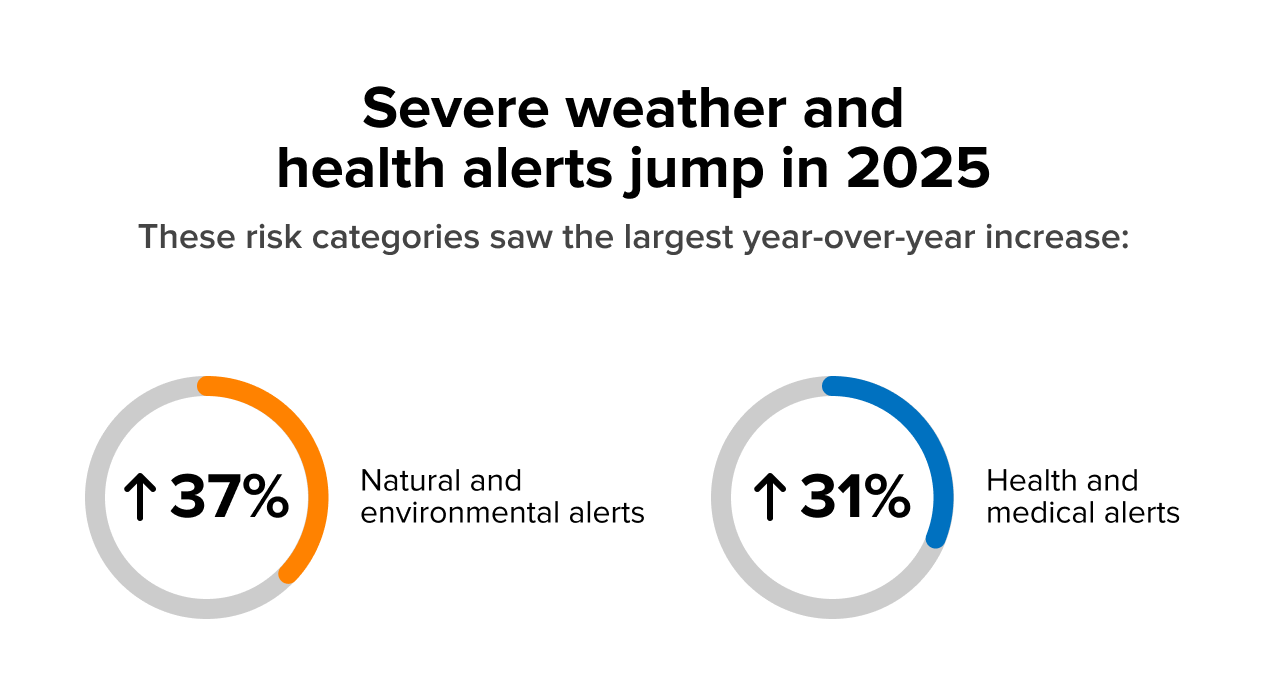
Driven by the growing frequency and severity of extreme weather events, natural and environmental alerts increased by over a third—reflecting intensified heatwaves, wildfires, and hurricane and typhoon seasons across the globe.
“The biggest challenge today is unpredictability, so being aware and prepared turns potential crises into manageable situations.” - Suzanne Sangiovese, CEO of Riskline
As extreme weather events increase, travelers should prepare for related travel disruptions.
“Climate risks aren’t going to be the main driving force for how you choose a destination, but once you have chosen a destination, Risk Alerts keep you aware of the things that could impact your travel,” shared Moyse.
“In the short term, this means building contingency plans like packing for changing conditions, budgeting extra time, and preparing for sudden disruptions. In the long term, it reinforces the need to stay adaptable and informed. Travelers shouldn’t avoid entire regions because of risk, but rather consider what they would do if disruptions arise—whether that’s identifying local emergency resources or making sure communication plans are in place.”
Related reading: 5 Easy Ways to Share Your Travel Plans with TripIt
4. Global risk alert volume peaked in July 2025
According to Riskline, myriad factors affect the total number of alerts in a given month, but major world events, such as the outbreak of war, a large hurricane or other seasonal weather patterns, can cause temporary spikes.
Case in point: in June and July of this year, alert volumes surged.
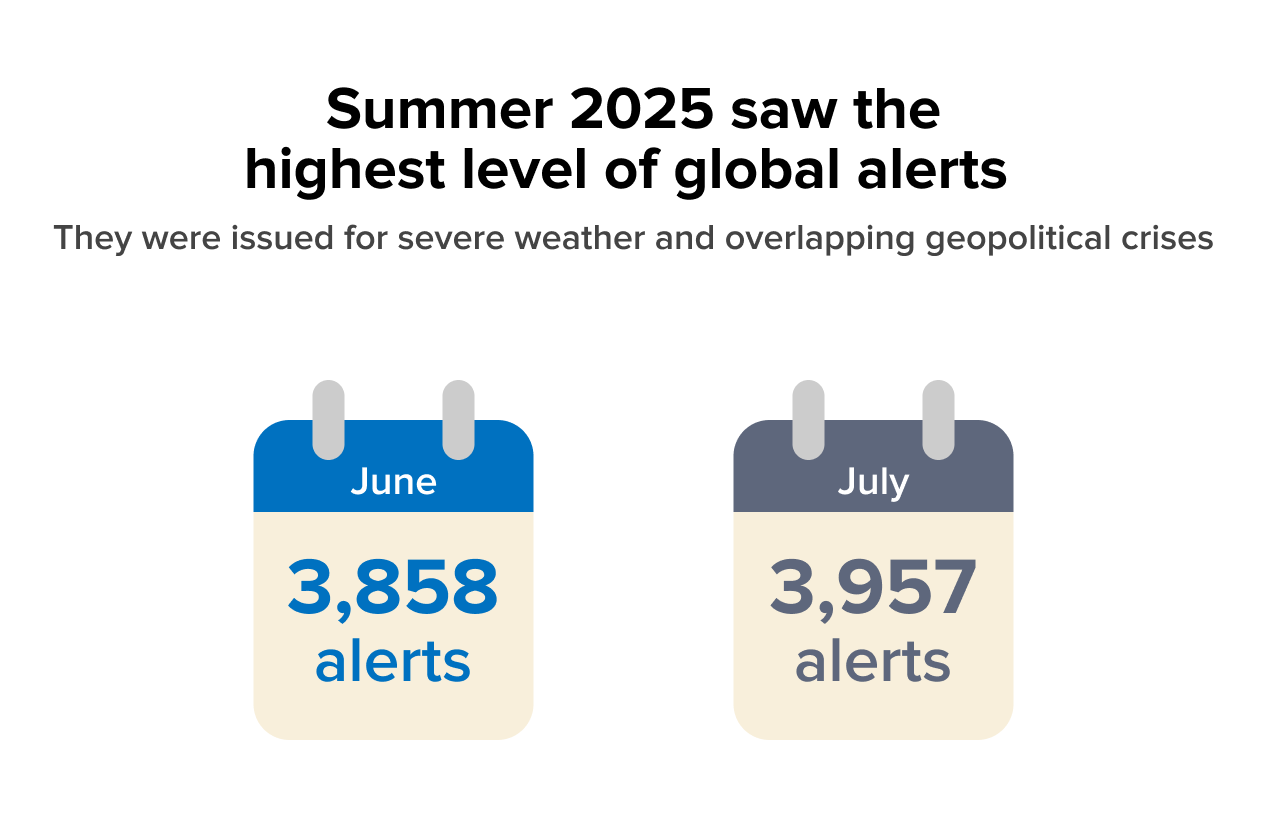
In the Asia-Pacific region, the early onset of the Southwest monsoon season affected several South and Southeast Asian countries, adding to the high alert volume this summer.
Europe also saw a rise in weather-related alerts, with orange and red warnings for heatwaves and thunderstorms. An increase in wildfires and related travel disruptions across the continent further contributed to the peak.
Conflicts and wars in the Middle East contributed to the surge, as well.
What might this mean for the future of travel? “We’re already seeing the industry adjust,” said Moyse. “Airlines are refining their scheduling and customer support policies to better handle delays, and passenger-rights laws in some regions, like Europe, that compensate travelers when disruptions occur.
“At the same time, governments are tightening security but also rolling out faster, tech-enabled solutions such as biometric screening. While security and weather-related challenges may grow, travelers can also expect innovations designed to reduce friction and improve the overall experience.”
5. TripIt helps travelers stay informed in the new normal
We’re experiencing a new normal of travel—one powered by more information and better tools to help plan, assess risk, and adapt on the fly. Instead of a static baseline, travelers should expect ever-richer data, faster notifications, and smoother pivots when plans change.
“TripIt plays a critical role here: giving travelers a single place to organize every aspect of a trip, from flights and hotels to restaurant reservations and event details,” said Moyse. “By consolidating plans, travelers reduce stress and gain stability even when disruptions arise.”
Plus, TripIt Pro users benefit from real-time flight alerts and destination-specific risk updates, while features like Neighborhood Safety Scores, local emergency contacts, and stored travel documents provide peace of mind.
“Folks are approaching travel with more awareness and practical strategies. They’re absorbing alerts and adjusting plans rather than canceling. Travelers want information, and when they have it, they’re more willing to keep moving despite uncertainties.”
The result is less scrambling—and more confident, real-time decision-making.
Methodology: TripIt partnered with Riskline to assess global risk alert volume and growth, alert trends, as well as geographic patterns and risk hotspots between August 1, 2024, and July 31, 2025. The data is based on Riskline's historically published alerts. Riskline applies the following seven categories to each alert, based on the event’s root cause, motivation, or outcome: Demonstrations and Unrest; Health and Medical; Conflict and Terrorism; Crime; Natural and Environmental; Travel Safety and Disruptions; and Political Developments. Riskline recently won the inaugural Duty of Care Provider Award at the Business Travel Awards Europe 2025, recognizing its real-time travel risk intelligence.